
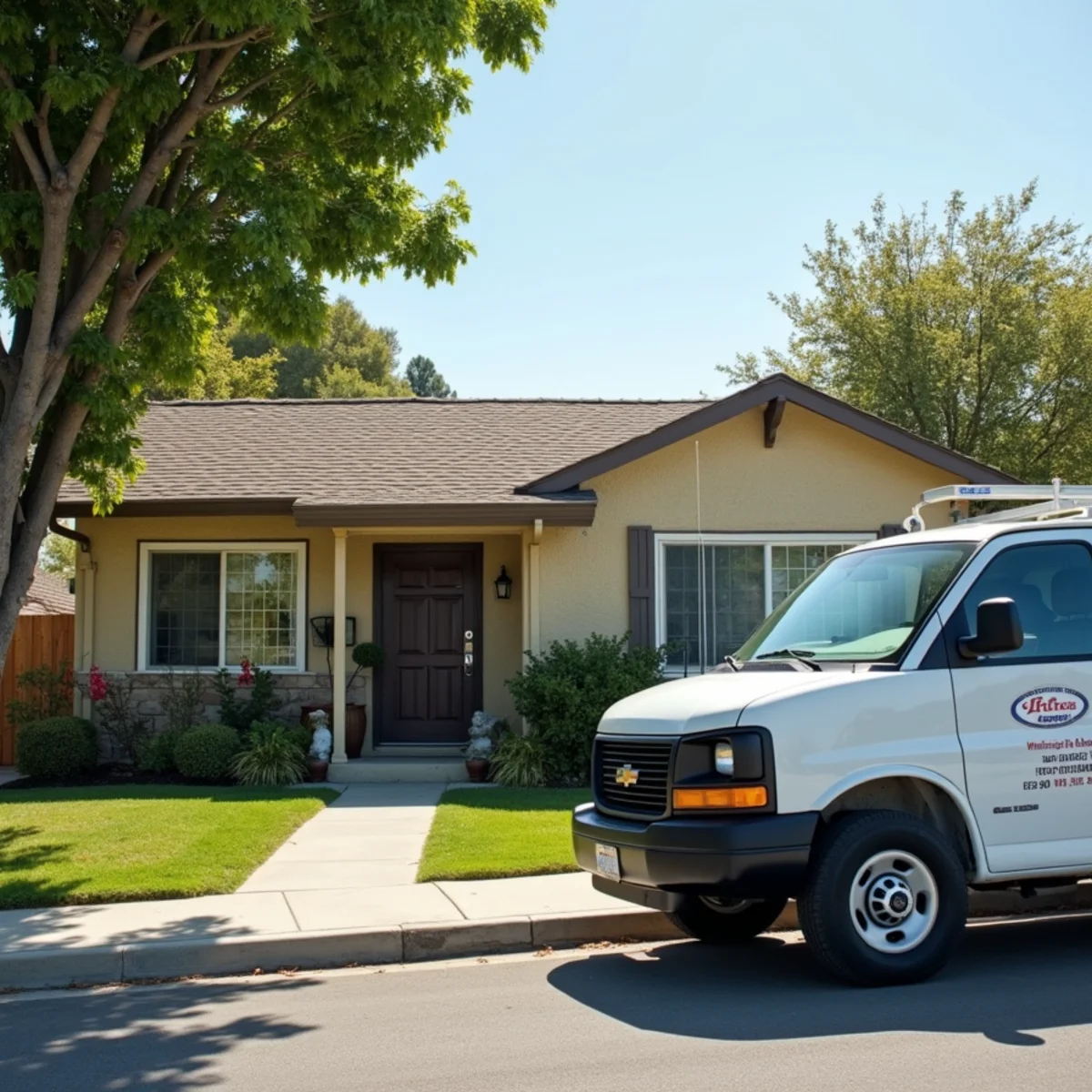
Whittier climbs from the flats up into the hills at the northern edge of our range, an old Quaker-founded town with a genuinely walkable Uptown core. We reach it in about twenty to twenty-five minutes up the 605. Its notable flood exposure sets it apart from the flat tract cities closer to Lakewood, and we know its two very different halves well.
We are on call 24/7 and work directly with your insurer from the first visit. Whittier pairs 1950s and 1960s slab tracts with the flood risk of the Whittier Narrows, so our calls here range from a routine pipe leak in a bungalow to serious storm-season water intrusion on the valley floor.
Fast response to Whittier
Dispatched from 3700 N Industry Ave, Lakewood, CA 90712. Call (201) 277-9344 — we answer live, 24/7.
Water Damage Risks in Whittier
Whittier's postwar tracts, built from the 1950s through the 1970s, sit on slab foundations across the valley floor and up the lower slopes. The plumbing is the familiar regional mix of aging galvanized and copper, now at the stage where under-slab leaks have become a common reason for our visits here.
Flood exposure is the local wrinkle that shapes winter work. A large share of Whittier's buildings — roughly a quarter — carry meaningful flood risk tied to the Whittier Narrows Dam and the broader San Gabriel system. In wet years, that turns an ordinary storm into a real intrusion threat for low-lying homes.
Local Knowledge You Can Count On

We work Uptown Whittier along Greenleaf Ave, the neighborhoods near Whittier College, and the streets running down toward the Whittier Narrows. The shift from hillside homes to valley-floor tracts changes what we watch for on each call, from slope runoff up top to standing water down below.
A typical Whittier call in a wet winter is a valley-floor home taking water as the ground saturates and a nearby drain backs up. We regularly extract quickly, disinfect the intruded area because that water often reads as Category 3, and dry the slab before the moisture reaches the framing.
Water damage we handle most in Whittier
Whittier faces water from two directions: slope runoff off its hillsides and the flood risk from the Whittier Narrows below. Heavy storms send both toward homes at the same time. Flood cleanup and storm recovery are what Whittier residents call us for most.
Flood Cleanup
Complete flood cleanup for Lakewood homes and businesses after storms and major overflows, including water removal, sanitizing, drying, and disposal of unsalvageable materials.
Learn moreStorm Damage Cleanup & Restoration
Storm damage cleanup for Lakewood properties after winter rains and Santa Ana winds — emergency tarping, water extraction, debris removal, and full drying.
Learn moreFlooded Basement & Crawl Space Cleanup
Water removal and drying for Lakewood crawl spaces, sunken rooms, and the rare basement — pumped out, dried, and sanitized to stop mold and structural damage below.
Learn moreOur services in Whittier
Every part of the job, handled by one local crew.
Water Damage Restoration
Full water damage restoration for Lakewood homes and businesses — extraction, drying, and repair, with direct insurance billing and crews dispatched around the clock.
Learn moreFlood Cleanup
Complete flood cleanup for Lakewood homes and businesses after storms and major overflows, including water removal, sanitizing, drying, and disposal of unsalvageable materials.
Learn moreStorm Damage Cleanup & Restoration
Storm damage cleanup for Lakewood properties after winter rains and Santa Ana winds — emergency tarping, water extraction, debris removal, and full drying.
Learn moreStructural Drying & Dehumidification
Certified structural drying and dehumidification for Lakewood properties, using air movers and industrial dehumidifiers to dry framing, subfloor, and drywall to a measured target.
Learn moreSlab Leak Water Damage Restoration
Slab leak water damage restoration in Lakewood — locating leaks beneath the foundation, drying the affected floors and walls, and restoring the damage a hidden leak leaves.
Learn moreMold Remediation
Certified mold remediation for Lakewood properties — containment, safe removal, and moisture correction so the mold does not simply grow back after cleanup.
Learn moreWhy Choose Us
Why Whittier residents choose Water Damage Lakewood
60-minute dispatch across Lakewood
Crews dispatched from Lakewood — we aim to be on-site within about an hour, because water spreads by the minute.
Answered live, 24/7
A real person picks up day or night, weekends and holidays, and gives you clear steps while we head your way.
IICRC-Certified Technicians
We dry to the IICRC standard using moisture meters — not guesswork — so your home is verified dry, not just dry to the touch.
We handle your insurance
Photo and moisture documentation, adjuster-ready scopes, and direct billing on covered losses.
Licensed & Insured
Local crews with 15+ years of restoration experience — accountable, local, and easy to reach.
Whittier: Water Damage FAQs
How long does it take you to reach Whittier?
About 20–25 minutes north via the 605 from our Lakewood base. We aim to be on-site within about an hour for emergencies, and we arrive ready to extract standing water and begin structural drying, whether the source is a failed pipe inside the home or storm water pushing in from the street outside. Call +1 (201) 277-9344.
Is Whittier really at higher flood risk?
Yes. A large share of buildings — around a quarter of the city's stock — sit within the Whittier Narrows flood exposure zone. That makes storm-season intrusion a genuine, recurring concern here in a way it simply is not for the drier inland tracts, and it is worth keeping ground-floor valuables off the floor in winter.
What is your response time to Whittier?
Whittier is a bit farther from our Lakewood base than our closest cities, but we still aim to arrive quickly, often near the 60-minute mark. We are available 24/7 for Whittier emergencies. Freeway access helps us reach the area without long delays.
Do Whittier's hillside homes see different water damage?
Whittier has both flat tracts and hillside homes, and on the slopes water tends to run down and collect in lower rooms. We track where the water settled and dry those low points in Whittier homes. During storms, we also look for runoff finding its way inside.