
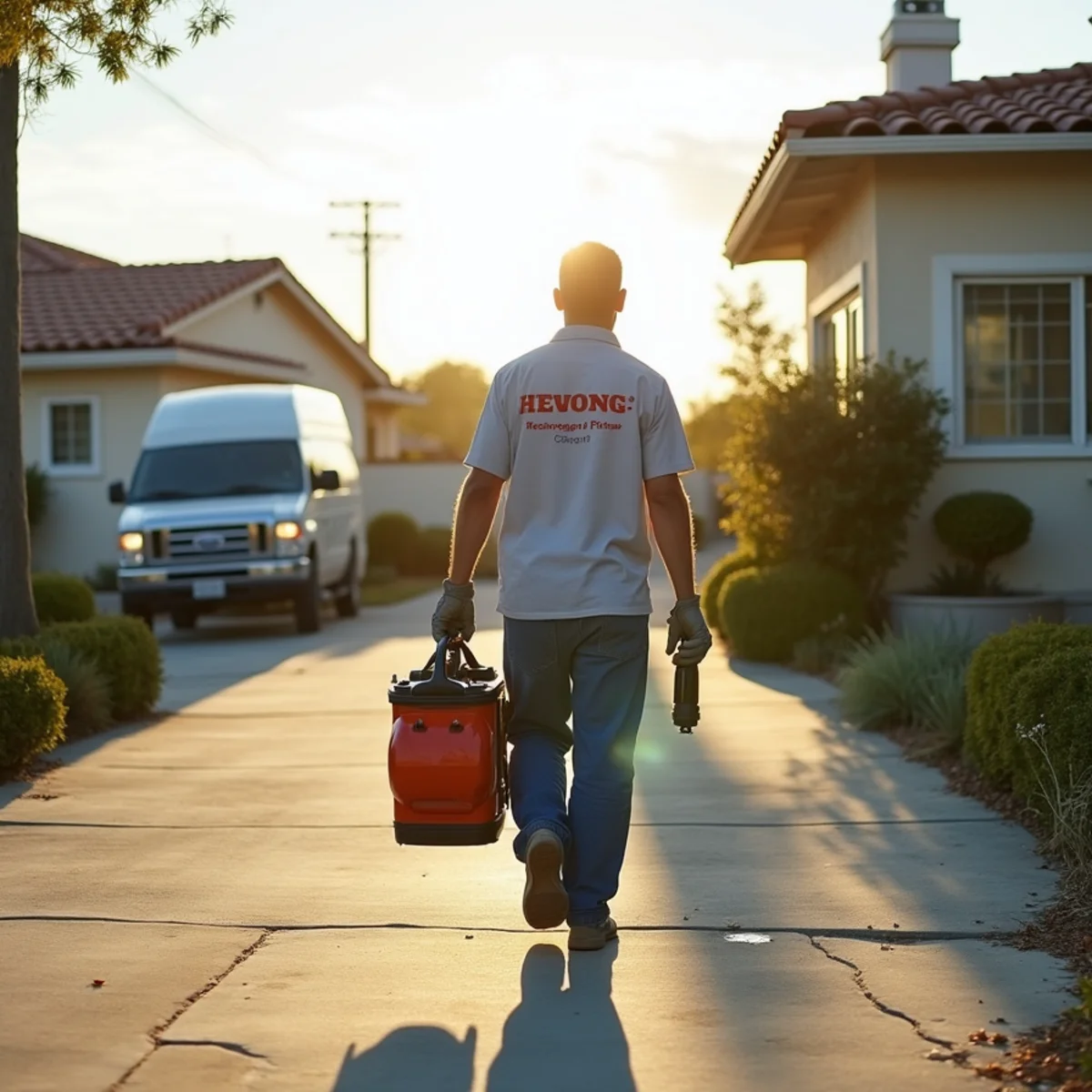
Bellflower sits right on Lakewood's northern line, so we treat it as home turf. A call here is a short run up Bellflower Blvd, often five to eight minutes door to door. That closeness matters when a supply line lets go, because every minute of standing water pushes the damage further into floors, walls, and cabinets.
We answer 24/7, arrive with truck-mounted extraction, and start structural drying before mold gets a foothold. Bellflower's older single-family tracts and its dense apartment blocks each bring their own kind of water problem, and we have worked both sides of the city for years.
Fast response to Bellflower
Dispatched from 3700 N Industry Ave, Lakewood, CA 90712. Call (201) 277-9344 — we answer live, 24/7.
Water Damage Risks in Bellflower
The name traces back to "Bellefleur" and the flower fields that once covered this land. Those farms gave way to 1950s and 1960s tracts, built on clay-loam soil that expands when it rains and pulls back hard when it dries. Slabs and the pipes cast into them feel every one of those seasonal cycles.
Much of the original galvanized plumbing is now seventy-plus years old. Inside the walls it corrodes from the inside out, weeping quietly for weeks before it fails outright. On this soil, a slow slab leak often shows up as a warm spot underfoot or a lifting corner of flooring long before you ever see standing water.
Local Knowledge You Can Count On
We run calls all over Bellflower — the neighborhoods around Simms Park and Thompson Park, the residential stretch along Somerset Blvd, and the apartment rows off Bellflower Blvd near Rosecrans. The steady mix of owner-occupied tracts and rental units keeps our crews busy across the city year-round.
A typical job near Somerset is a laundry supply line that splits behind a wall and soaks the adjoining bedroom carpet overnight. We regularly pull the baseboards, dry the wall cavity from both sides, and save the slab-side framing before it warps or grows mold.
Water damage we handle most in Bellflower
Bellflower's 1950s and 60s tract homes sit on slabs poured over clay-loam soil. That soil swells and shrinks with the seasons, and the movement stresses the copper and galvanized lines run under the concrete. Most of our Bellflower work starts as a slow slab leak someone caught late.
Slab Leak Water Damage Restoration
Slab leak water damage restoration in Lakewood — locating leaks beneath the foundation, drying the affected floors and walls, and restoring the damage a hidden leak leaves.
Learn moreLeak Detection
Non-invasive leak detection for Lakewood homes, using acoustic and thermal tools to pinpoint slab, wall, and yard leaks before they cause major damage.
Learn moreWater Damage Restoration
Full water damage restoration for Lakewood homes and businesses — extraction, drying, and repair, with direct insurance billing and crews dispatched around the clock.
Learn moreOur services in Bellflower
Every part of the job, handled by one local crew.
Water Damage Restoration
Full water damage restoration for Lakewood homes and businesses — extraction, drying, and repair, with direct insurance billing and crews dispatched around the clock.
Learn moreSlab Leak Water Damage Restoration
Slab leak water damage restoration in Lakewood — locating leaks beneath the foundation, drying the affected floors and walls, and restoring the damage a hidden leak leaves.
Learn moreBurst Pipe Cleanup & Water Damage Repair
Rapid burst pipe cleanup for Lakewood homes — shutoff help, water extraction, and structural drying after a supply line or pipe fails and floods the space.
Learn moreMold Remediation
Certified mold remediation for Lakewood properties — containment, safe removal, and moisture correction so the mold does not simply grow back after cleanup.
Learn moreStructural Drying & Dehumidification
Certified structural drying and dehumidification for Lakewood properties, using air movers and industrial dehumidifiers to dry framing, subfloor, and drywall to a measured target.
Learn moreCeiling Water Damage Repair
Ceiling water damage repair for Lakewood homes — we trace the leak, dry the framing above, and restore stained or sagging ceilings so the damage does not return.
Learn moreWhy Choose Us
Why Bellflower residents choose Water Damage Lakewood
60-minute dispatch across Lakewood
Crews dispatched from Lakewood — we aim to be on-site within about an hour, because water spreads by the minute.
Answered live, 24/7
A real person picks up day or night, weekends and holidays, and gives you clear steps while we head your way.
IICRC-Certified Technicians
We dry to the IICRC standard using moisture meters — not guesswork — so your home is verified dry, not just dry to the touch.
We handle your insurance
Photo and moisture documentation, adjuster-ready scopes, and direct billing on covered losses.
Licensed & Insured
Local crews with 15+ years of restoration experience — accountable, local, and easy to reach.
Bellflower: Water Damage FAQs
How quickly can you get to Bellflower?
Usually within about 15 minutes for the initial visit — it is a short run north from our Lakewood base. For emergencies we aim to be on-site within 60 minutes at the outside, with extraction gear ready to start the moment we arrive.
My slab leak barely shows. Is it urgent?
Yes. On Bellflower's clay-loam soil, slow slab leaks undermine the slab and feed mold inside walls, and mold can start within 24–48 hours. The sooner we locate and dry it, the smaller the repair and the lower the cost. Call +1 (201) 277-9344.
Do you handle apartment and rental water damage?
We do, often. Bellflower has a lot of rental stock, and we coordinate access with tenants, owners, and property managers on the same call, then document the loss so the owner's claim is well supported.
How quickly do you get to Bellflower after a water emergency?
Bellflower sits right next to our Lakewood base, so it is one of the closest cities we serve. We usually reach Bellflower homes in around 60 minutes or less, any hour of the day. Because we are so near, a burst pipe there gets a fast start on extraction.
What plumbing problems are common in Bellflower's older homes?
Many Bellflower houses date to the 1950s and 1960s and still run on galvanized supply lines that corrode from the inside. Those pinhole leaks often go unnoticed until they soak a wall or slab. We locate the source, dry the structure, and document everything for your insurer.